
Semiconductor Fault Isolation Equipment

Precision Fault Isolation with Magma

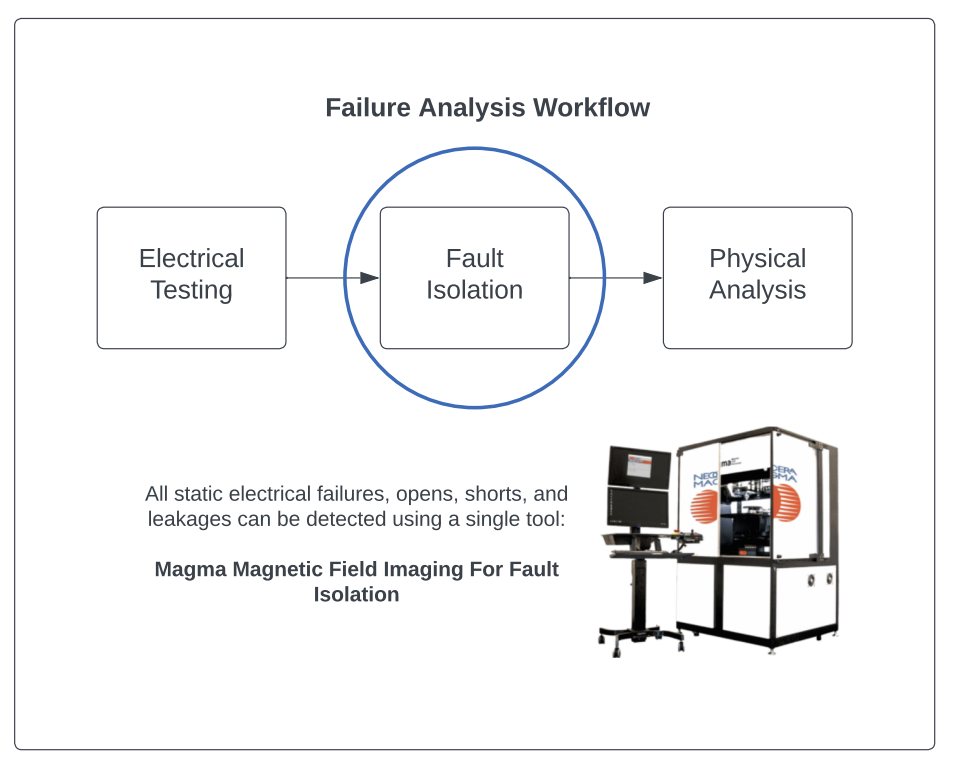
Our Magma delivers a powerful, non-destructive solution for detecting and localizing electrical faults—such as opens, shorts, leakage paths, and high-resistance opens—in both packaged and unpackaged semiconductor devices.

Orozco, A. et al. "3D Fault Isolation in 2.5D Device comprising High Bandwidth Memory (HBM) Stacks and Processor Unit Using 3D Magnetic Field Imaging," paper presented to ISTFA, Fort Worth, TX, November 6-10, 2016. A collaboration with AMD Singapore.

Shorts

A short is caused by unintended electrical contact between two conductors, typically with resistance of an ohm or less. Magma’s Magnetic Field Imaging (MFI) technology is highly effective at detecting shorts in all materials used in semiconductor manufacturing today.

Key Features of Our Magma:

  • Detects shorts through all common packaging materials.
  • Localization accuracy up to 250 nm using the high-resolution sensor GMR.
  • Detects shorts from over 10 mm away using the high-sensitivity sensor (SQUID).

Opens

Magma uses Space Domain Reflectometry (SDR), also known as Magnetic Current Imaging, using RF signals to locate the fault. Unlike Time Domain Reflectometry (TDR), SDR will enable you to isolate the open without deprocessing the chip.

Key Features of Our Magma:

  • Stimulates the circuit with 20–200 MHz RF signals.
  • Detects standing wave decay near open faults.
  • Works on dies, wafers, and packages.
  • Does not require a signal to be injected directly at the fault or on the defective fault line.

Gaudestad, J. et al. "Magnetic Current Imaging and Photon Emission for Die Level Electrical Fault Isolation." Paper presented to NanoTesting, Osaka, Japan, September 2015. A collaboration with Microchip Technology Inc.

Leakages

Leakage faults, unintended electrical paths between circuits, often with current in the nanoamp range. The Magma can detect these subtle faults due to the sensitivity of the SQUID sensor.

Key Features of Our Magma:

  • Detects very low current signals (nanoamps).
  • Ideal for finding high-resistance leakages in more complex multidie devices.
  • High sensitivity enables precise localization.

Chen, Y-H J. et al. "High Resistance Open Localization." Presented at IPFA, Hsinchu, Taiwan, Jun 29 - Jul 2, 2015. A collaboration with Honyang and TSMC.
High-Resistance Opens

These defects allow limited current flow due to resistance above specification. Magma detects them by comparing known-good samples with faulty ones.

Key Features of Our Magma:

  • Uses comparative analysis to identify fault location.
  • SQUID sensor detects minute changes in circuit geometry.
  • Effective even when signals are weak or intermittent.

 Using advanced quantum sensors and proprietary techniques, Magma enables precise localization of all static defects, even in complex, multi-layer structures. It provides detailed magnetic imaging that can also be used for 3D fault isolation software currently being developed, helping engineers rapidly pinpoint defects with micron and submicron accuracy.


Sensor Technology for Every Scale

  • SQUID (Superconducting Quantum Interference Device): Offers high-sensitivity, micron-scale fault detection for deep-buried defects at the package level.
  • GMR (Giant Magneto Resistance) Sensor: Enables submicron resolution at the die level.

One Tool. Multiple Technologies Replaced.

Magma's simplified fault isolation process resplaces this entire suite of tools:

 
  • Thermal Imaging
  • Photon Emission
  • OBIRCH
  • TIVA/LIVA
  • TDR
  • EOTPR


With our Magma, engineers gain faster, more accurate diagnostics—without the complexity of managing multiple instruments.